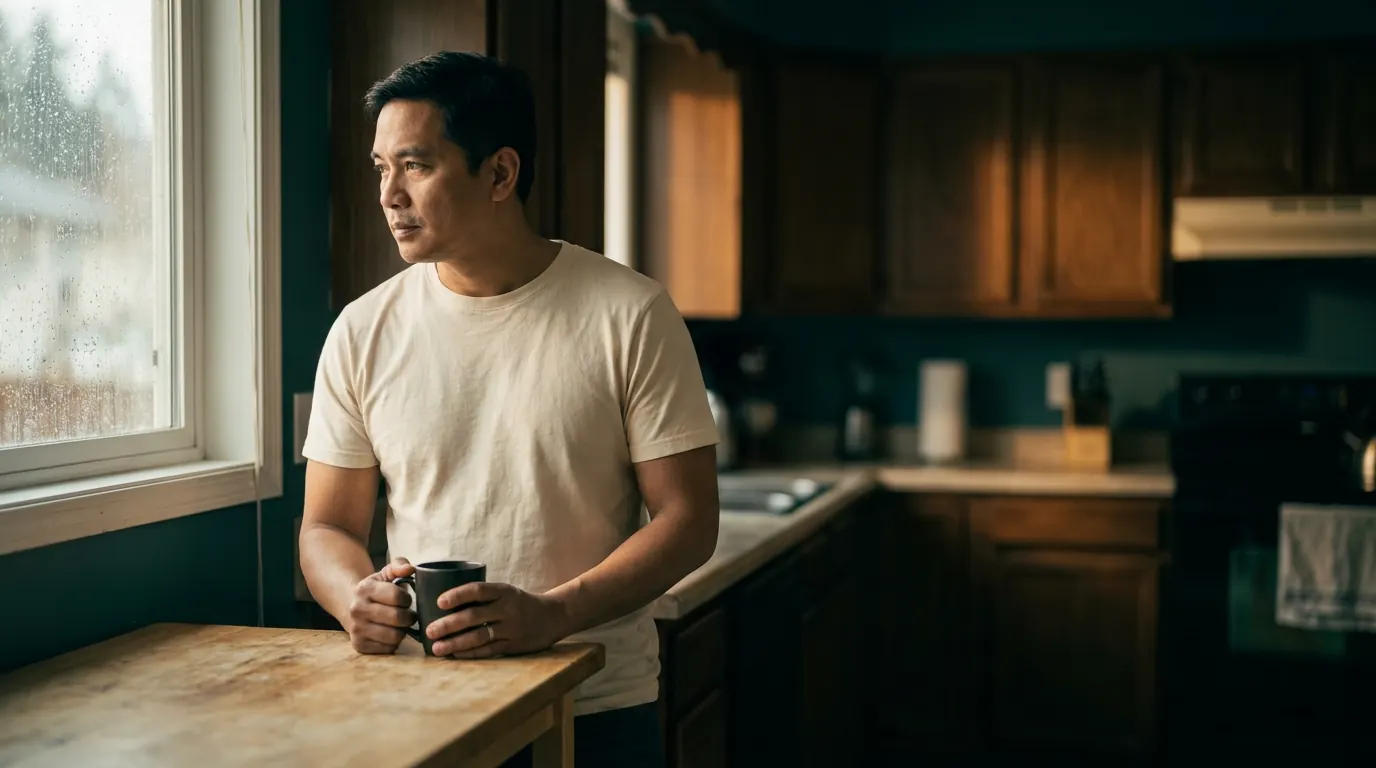
Still unsure what a visit actually involves? What happens at a first visit, start to finish — the part that stops most people booking is imagining the room.
The hiya gap
There is no English equivalent for hiya. It is not just embarrassment. It is the cluster of shame, social exposure, fear of being seen, and quiet humiliation that — for many Filipino men — sits between the first time they notice a problem and the first time they tell anyone about it. Nakakahiya kasi. And so they do not say it.
It is one of the most consistently observed patterns in Philippine urology practice: the average delay between first ED symptoms and first clinic visit is somewhere between five and ten years, according to internal data from Manila men's-health practices. By the time a Filipino man walks into a clinic with ED, the condition has usually been quietly worsening for half a decade. Tahimik lang. Hindi pinag-uusapan.
This delay is not a personal failure. It is the predictable outcome of a culture where sex is not discussed, where male strength is conflated with sexual performance, where extended family often lives in the same household, and where every potential clinical setting feels like a place someone might recognise you. Baka may makakita. Baka may magsabi sa kapatid ko. Hiya is the rational response to that environment. The challenge is that hiya is also costing Filipino men years of treatable, addressable ED — and often, alongside it, years of quiet intimate disappointment for the couple.
This piece is the quietest, most honest version of the answer to the question almost every man asks himself before booking: kung pumunta ako, ano ba talaga ang mangyayari?
What actually happens at a private clinic visit
At a discreet boutique clinic — the kind that is genuinely private, not just marketed that way — a first ED consultation looks like this:
Before the visit. You book through whichever channel feels easiest: web form, WhatsApp, Viber, phone, Facebook. A real person replies, usually within hours. The confirmation message uses neutral language — no mention of ED, no mention of why you booked. Walang lalabas sa text. You are given an appointment time that does not overlap with another patient's exit.
Arrival. You walk into a quiet building — in our case, a private second-floor unit in Makati, reached without passing a street-front reception. You ring the doorbell. You are greeted by name — or by initials if that is how you booked. The waiting area, if there is one, is enclosed and empty of other patients.
The conversation. The clinician sits across from you, not behind a desk barricade. The opening is typically: 'What brings you in today?' or, in Taglish, 'Anong concern natin today?' — depending on which feels right for you. You tell them what brought you in, only what you want to. Most men start with the symptom; some need the clinician to ask a follow-up question or two before the actual concern surfaces. Either is normal. The clinician does not flinch, react, or moralise. Hindi sila magugulat. They have heard this conversation many times before; you are not their first patient with this concern and you will not be their last.
The IIEF-5 questionnaire. The clinician walks you through the International Index of Erectile Function — 5 questions about erection quality, frequency, and confidence over the past 6 months. You can also have completed this on our website before the visit, in which case the conversation in the room is shorter and starts from your scores. The score categorises severity: mild (17-21), mild-moderate (12-16), moderate (8-11), severe (5-7). The score itself is often a relief — it externalises what has been a vague worry into a number with a defined response.
Cardiovascular screening. The clinician asks about blood pressure history, family cardiovascular history, smoking, diabetes, lipids if known. This part is short — 5 to 10 minutes — but important. ED in men over 40 is often a vascular warning sign, and the consultation that doesn't address the cardiovascular layer is missing the bigger clinical picture.
Options discussion. Based on the score and the picture, the clinician walks you through the realistic options: medication (PDE5 inhibitors), focused shockwave therapy, lifestyle changes, combination therapy, and — for some patients — psychological factors that may be a meaningful part of the picture. You are given honest pricing, honest timelines, and honest expectations about response rates. You are not pressured to start treatment that visit. Many patients leave to think about it; many decide on the spot.
Total visit time. 30 to 45 minutes for most first consultations. Shorter than most men expect.
What does not happen
It is worth being explicit about what a routine first ED consultation does not include:
- No physical examination of the genitals. The vast majority of ED diagnoses are built from history, IIEF-5, and cardiovascular workup. A genital exam is performed only if a specific physical concern arises (e.g., visible Peyronie's plaque, history of trauma) — and only with the patient's consent and full understanding of why.
- No blood tests at the first visit. If labs are needed (testosterone, lipids, glucose), they are ordered for a follow-up visit at a lab of your choosing.
- No camera or photographs. Ever. Not for marketing, not for records, not for any reason without specific written consent for a specific clinical purpose.
- No moralising or judgement. Not about porn use, not about the number of partners, not about anything else. The clinician's job is to address the medical issue, not to grade your life.
- No sales pressure to buy a package on the spot. If you are pressured to buy multiple sessions before leaving the room, that is a sign you are at the wrong clinic.
- No record of the visit shared with your HMO, employer, or family without your explicit consent. The Data Privacy Act and the Medical Act protect this; reputable clinics treat it as foundational.
Yung mga bagay na alam ng Manila clinician
Most Manila men's-health clinicians understand the cultural context they're working in. Specifically:
- Hiya is real and rational. Hindi ka pipilitin magsalita kung ayaw mo pa. They are not going to push you to share more than you want to.
- Manila is small. Maliit ang Maynila. They understand that you may know people who go to nearby clinics, work in nearby offices, attend the same parish. Single-patient scheduling exists exactly for this reason.
- Multi-generational living is the norm. They understand that 'iisipin ko muna, kakausapin ko si misis' often also means 'kailangan kong maghintay ng moment na wala si nanay sa kabilang kuwarto.'
- HMO use creates paper-trail concerns. Lalabas ba 'to sa HMO statement? Reputable clinicians will discuss billing options and exactly what shows up where, before you commit.
- You may want to come back without coming back. Follow-up by message or short video call — chat na lang — for non-procedural conversations is offered at most reputable clinics.
How to lower the friction (paano gawing mas madali)
If hiya is what has been standing between you and the visit, there are small things that lower the friction:
- Take the Sexual Wellness Assessment online first. Our 3-minute IIEF-5 + PEDT self-check gives you the scores and a private PDF — walang papirma, walang email kailangan. Walking into the consultation already knowing your score makes the first conversation shorter and easier.
- Book through a channel that doesn't require talking. 'Wag ka munang tumawag kung ayaw mo. WhatsApp or the web form is the easiest first contact for most men — you can write, edit, and send when you're ready.
- Bring your wife or partner if it would help — or come alone. Many couples come together for the first ED consultation. Many men come alone. Pareho lang, walang tama o mali.
- Book a slot that doesn't overlap with your normal schedule. A Saturday morning slot at a discreet clinic means the visit doesn't sit inside your workday or your usual routine. Walang dapat ipaliwanag sa office.
- Ask whatever you need to ask before booking. Tanungin mo lahat ng gusto mong itanong — reputable clinics will answer questions on the messaging channel before you commit to a visit.
- If you're not ready to book, read. Our blogs on shockwave vs medication, ED as cardiac warning, and ED shockwave cost in Manila answer most of the questions men have before the first visit. Pwede munang magbasa.
Ang pinakamadalas na sinasabi pagkatapos
Across the Filipino men we see at first ED consultation, the most common reaction at the end of the first visit — almost word for word — is some version of: 'Sayang, dapat mas maaga pa ako pumunta.' Partly because the visit is much shorter and less exposing than they had pictured. Partly because the treatment options actually work for most men. Mostly because the relief of having said the thing out loud, in a setting where no one flinched, is often larger than they had let themselves anticipate.
Hiya kept them away for years. The consultation itself took 35 minutes.
Limang taon ng tahimik na alalahanin para sa 35-minutong usapan. If that math seems wrong to you sitting here reading this — if five years of quiet worry seems disproportionate to a 35-minute conversation — you are not wrong. It is disproportionate. The hard part really is walking through the door. Yung pagpasok lang sa pinto ang mahirap.