Wondering about cost? See the full published price list by severity.
What this treats
Genital warts — kulugo sa ari — are caused by low-risk human papillomavirus (HPV), most commonly types 6 and 11. People describe them in all sorts of ways when they call: butlig, kulugo, a bump that wasn't there last month. All of it is the same conversation, and none of it is one we find remarkable. They appear as soft, flesh-colored to slightly pigmented papules, cauliflower-like growths, or flat plaques on the penile shaft, glans, foreskin, scrotum, vulva, perineum, or perianal skin. We treat external visible warts. Internal urethral and anal canal lesions are handled in coordination with a specialist clinic and referred where appropriate.
How is genital warts removal done?
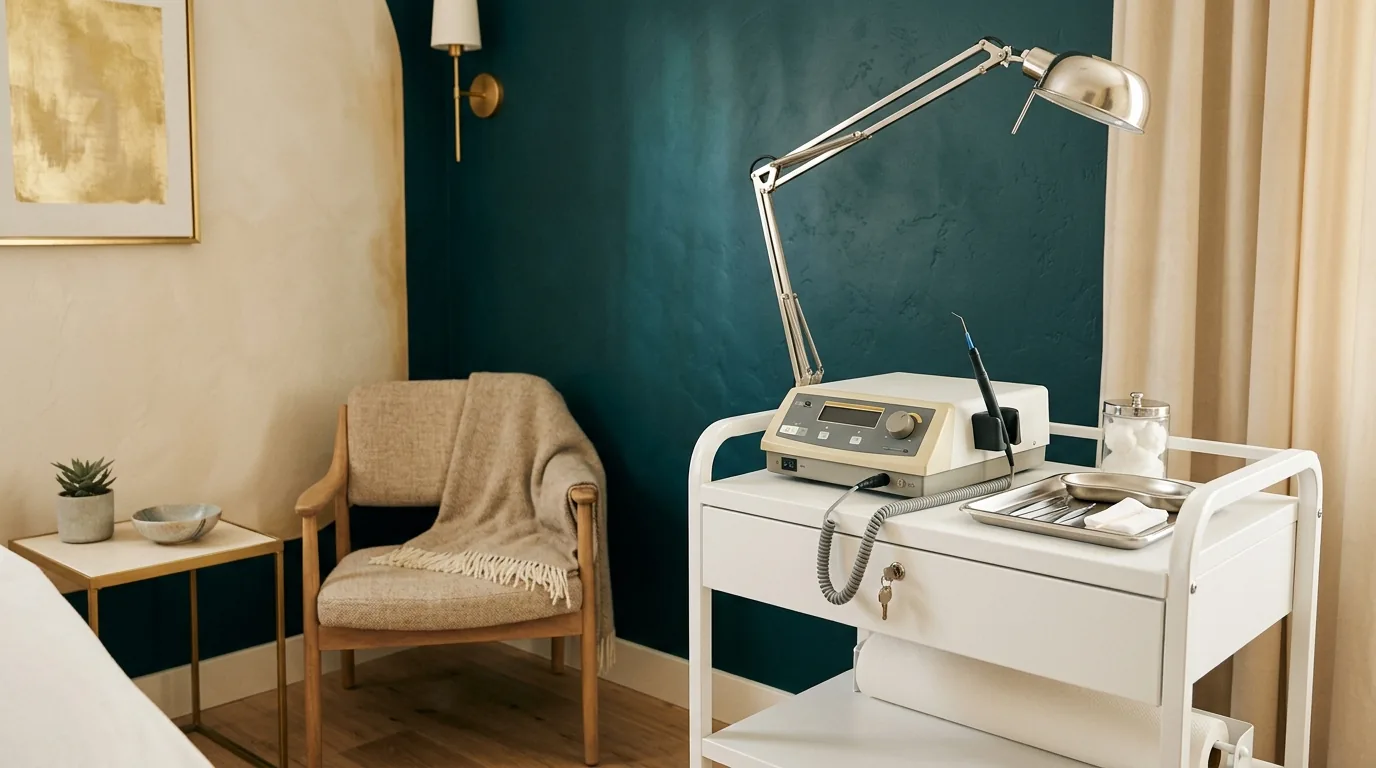
Two methods, matched to the lesion — electrocautery and CO₂ laser, both under local anaesthetic. Which one is used is a clinical decision made at the consultation, and it does not change what you pay: the severity band sets the price, not the device.
Electrocautery — a fine heated tip that removes the wart tissue precisely. It is one of the standard first-line treatments for external genital warts, it works in a single pass on most lesions, and it gives good control over depth, which is what protects the skin around it.
CO₂ laser — ablation with precise depth control, which is why it is generally chosen for extensive or recurrent disease and for lesions in delicate sites.
We do not offer cryotherapy or acid-based treatments. Two devices is not every device: if your case genuinely needs something we do not have, we will tell you and help you find it rather than treating you with the wrong tool.
- Under local anaesthetic. The area is numbed first — you should feel pressure, not pain.
- Usually one pass per lesion. Most mild and moderate cases are done in a single visit.
- Extensive disease is staged. Large or joined areas are treated across more than one visit rather than pushed through in one sitting, which is better for healing and for scarring.
Treatment clears visible warts. The immune system clears HPV. After successful removal, roughly 20–30% of patients experience new lesions within three months at adjacent sites — this is subclinical HPV in the surrounding tissue, not failure of treatment. After about 12 months without new lesions, the practical risk of recurrence becomes low.
What does a genital warts removal visit actually involve?
The first visit is a discreet, private consultation: full visual inspection in a private room, identification of treatment sites, discussion of method and severity-tier pricing, co-screening for other STIs if appropriate. Most patients begin treatment at the second visit, though small simple lesions can be treated the same day with consent.
Local anesthetic where needed, then the primary removal pass. 20–90 minutes depending on severity — a single small lesion is quick; extensive or joined disease is not. Mild discomfort during; well-tolerated post.
Confirm complete clearance of treated sites. Identify any new adjacent lesions (subclinical HPV emerging) and treat at the follow-up rate. Booked within 14 days rather than at four weeks: new growth can appear beyond that, and a later check finds more of it, not less.
Final assessment. Most patients are functionally well by this point. Discussion of HPV vaccination if not already done.
How much does genital wart removal cost?
Pricing reflects the actual work involved, not arbitrary packaging. You are given the severity classification and the written quote before anything is booked.
| Severity | What that means | Price | Sessions |
|---|---|---|---|
| Mild | A single small lesion, or a few scattered papules under 5 mm | ₱5,000 | One short session |
| Moderate | Multiple lesions, larger size, or partly joined together | ₱8,000 | One longer session, or two short ones |
| Severe | Extensive joined disease, or large lesions in delicate sites — staged across more than one visit | ₱15,000 | Staged over more than one visit |
| Follow-up under 12 weeks | New lesions found at the 14-day or 12-week check | ₱2,000 per visit | As needed |
The quote covers the procedure and basic aftercare. There is no separate consultation fee and no package to buy up front.
Anal canal lesions are not treated here — we refer to a colorectal specialist clinic; we can prepare the referral at no extra charge.
HPV vaccination — recommended even after diagnosis
The Gardasil 9 vaccine protects against 9 HPV types (6, 11, 16, 18, 31, 33, 45, 52, 58). Most patients with visible warts are infected with types 6 or 11 only — vaccination still offers prospective protection against the remaining seven, including the high-risk strains that drive most HPV-related cancers. Growing observational evidence also suggests vaccination after diagnosis modestly reduces recurrence. We offer it as a 3-dose adult course at the time of treatment — ₱7,200 per dose, ₱21,000 for the full course — all-in, with no separate administration fee. Full detail on our adult vaccinations page.
What about my partner?
HPV is transmitted skin-to-skin and has a latent period of months. By the time visible warts appear, most regular partners have already been exposed. Telling a long-term partner that they "gave" the wart is usually neither accurate nor helpful. Partners with no symptoms don't need to be examined; if they have visible lesions, we treat them as a separate course. We discuss the partner conversation at the consultation — many patients find this the most useful part of the visit.
Investment
From ₱5,000 by severity. Quote and severity classification given in writing at the consultation. Most patients reach full clearance over 1–3 visits within 12 weeks.
Why we look more expensive than the ₱700 you saw elsewhere
Search for this and you will find Metro Manila clinics advertising genital wart removal from around ₱700 to ₱4,500. Ours starts at ₱5,000. That gap is real on the sticker and worth explaining rather than hiding.
Those are per-session prices. Ours is the case. Genital warts rarely clear in one visit with the methods those prices usually refer to — cryotherapy typically takes two sessions or more — so a per-session headline tells you the entry fee, not the bill. "From ₱700" usually also means one small lesion; the price moves the moment there are several, and you find out while you are already in the chair.
Our ₱5,000 is the whole mild case: the severity classified and quoted in writing before anything starts, the procedure, basic aftercare, and no separate consultation fee. The 14-day check is part of the plan, not a new invoice.
The question to ask any clinic, including this one: "Is that per session or for the whole thing, and what happens if it takes three visits?" If the answer is vague, that is your answer.
What that price includes — and how to compare
The quote you are given is the whole price. It covers the procedure and basic aftercare, with the severity classification and the figure confirmed in writing before anything is booked. No separate consultation fee, no package, and no charge for preparing a referral if you need one.
Comparing us with somewhere else? Ask one question: “Is that the total, or do consultation and follow-up cost extra?” A quoted headline price and the amount you actually hand over are often two different numbers. Compare the total, not the sticker.
And you will be the only patient here. Appointments are single-occupancy — there is no shared waiting room and no overlap with another patient, so you will not see anyone else in the clinic. For a lot of people that is the part that decides whether they book at all.
Will they come back?
Some of the time, yes — and any clinic that tells you otherwise is selling something. Removal clears the visible lesion; it does not remove HPV from the skin, and the immune system needs months to suppress the virus. Recurrence within the first three months happens to a meaningful minority of patients. It is not a failed procedure and it is not something you did wrong.
What matters is how a clinic prices for it. New lesions identified at the 14-day or twelve-week check are ₱2,000 per visit — published, so nobody has to wonder whether the follow-up is where the real money was. We would rather quote recurrence honestly up front than treat it as an upsell when you are worried.
What should I ask before booking — anywhere?
You are welcome to bring these to us. You should also take them everywhere else you are considering, and the answers will tell you more than any price list.
| Ask this | Why it matters |
|---|---|
| Is that price per session or for the whole case? | The single biggest source of bill shock. Per-session quotes hide the total |
| Who actually does the procedure? | In some clinics it is not the person you consulted with |
| What happens if warts come back at four weeks? | Recurrence is normal. A clinic that has not priced for it has not planned for it |
| Will I be seen by anyone else on the way in or out? | Shared waiting rooms are the reason many people never book at all |
| Do you offer the HPV vaccine at the same visit? | Vaccination after diagnosis still protects against the types you have not met |
One more, less comfortable: ask whether they will tell you if it is not warts. Several things look like genital warts and are not — molluscum, pearly penile papules, skin tags, and a small number of things that need a biopsy rather than a removal. A clinic that removes first and identifies later is the wrong clinic.
How we look after you
Treated by a named clinician
Your treatment is carried out by Jas Macusi, RN — a PRC-registered Registered Nurse and our founder and lead clinician — you can verify her yourself by name in the PRC's free public registry at prc.gov.ph. You will know who is treating you before you arrive.
One patient at a time
Appointments are single-occupancy. There is no shared waiting area and no overlap with another patient — you will not see anyone else here.
Published price, no lock-in
Our prices are published openly on this page and billed one session at a time. No packages, no upfront lock-in, and a written quote before anything begins.
Where it happens
Genital warts removal is clinic-based — it needs the device and a proper treatment room — so it happens at our Makati clinic on Pablo Ocampo Sr. Ext., by appointment. For select other services, home or hotel visits can be arranged in advance.