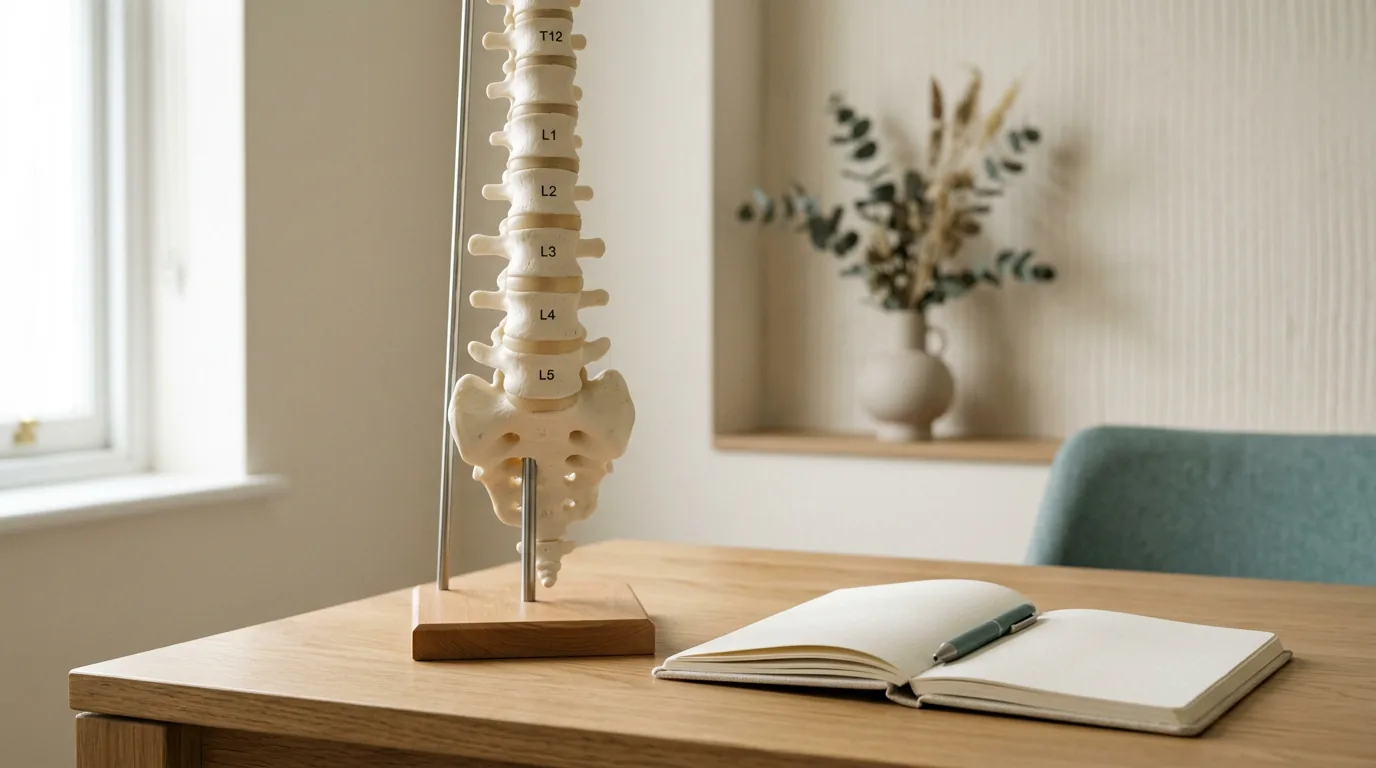
Spinal stenosis is one of those diagnoses that sends people straight to the internet looking for a way out that isn't an operation. That instinct is completely understandable, and PEMF — gentle, drug-free, no downtime — is exactly the kind of thing that looks appealing in that moment. So we want to give you the honest version rather than the hopeful one, because on this condition the honest version is the one that actually protects you.
What spinal stenosis actually is
Stenosis simply means narrowing. In the spine, it's a narrowing of the canal that the spinal cord and nerve roots travel through, usually in the lower back, and usually from the slow changes of age: thickened ligaments, bulging discs, bony overgrowth around arthritic joints. As the space tightens, the nerves get less room, and that produces the classic pattern — pain, heaviness, or pins-and-needles in the legs that comes on with standing and walking and eases when you sit or lean forward over a shopping cart. Doctors call that neurogenic claudication.
The important word in all of that is structural. The problem is a physical lack of space around a nerve. Keep that in mind, because it's the key to reading every treatment claim you'll encounter, including PEMF.
So can PEMF help?
Here's the careful answer. PEMF has been studied for back and nerve-related pain in general, and there is a small randomized study looking at it specifically in lumbar spinal stenosis that reported some symptom benefit.1 Alongside that sits a broader body of low-certainty evidence suggesting PEMF may modestly reduce low back pain in the short term.2 That's the whole of it. One small stenosis-specific study and some adjacent low-quality data is a thin foundation — not nearly enough to call PEMF an established treatment for stenosis, and a long way from the evidence behind exercise or surgery.
What PEMF might plausibly offer is a modest, low-risk nudge on the pain and inflammation around irritated tissue. What it cannot do is the thing that would actually treat stenosis.
PEMF cannot decompress a narrowed spinal canal. The only things that create more space around the nerve are changing your position and loading (which exercise and posture do functionally) or removing the tissue that's crowding it (which surgery does). PEMF sits outside that — it can only ever be optional symptom support, never a fix for the stenosis itself. Any clinic presenting it as a way to avoid needed treatment is overselling.
Why the "structural" point matters so much
It's worth spelling out, because it's the whole logic. If your knee hurts from a stalled tendon, a treatment that restarts healing can genuinely change the problem. Stenosis isn't a stalled healing process — it's a space problem. A magnetic field passing through the area doesn't add room where a thickened ligament and an arthritic joint have taken it away. This is the same reason we're cautious in our writing on PEMF for back pain: PEMF can support comfort and recovery, but it doesn't rebuild or remodel the structures causing mechanical pain.
What actually helps spinal stenosis
The good news, and it's real, is that a lot of stenosis is manageable without surgery, especially when it's mild to moderate. The approaches with genuine evidence behind them are unglamorous but effective.
- Exercise and physiotherapy — often flexion-based, because bending forward opens the canal slightly and relieves the nerve. Building tolerance for walking is a core goal.
- Activity modification and weight management — small changes in load and posture can meaningfully extend how far you walk before symptoms start.
- Epidural steroid injections — can reduce nerve inflammation and buy relief for persistent symptoms, as a step before considering surgery.
- Surgical decompression — for severe or progressive cases, this is the treatment that directly creates space around the nerve, and it has the strongest evidence for significant stenosis.
Where does PEMF fit in that picture? At most, as an optional comfort layer running alongside the exercise program for someone with mild-to-moderate symptoms who wants to try a low-risk adjunct. It should never displace the assessment and the core treatment. If a course of PEMF is the reason someone delays getting properly evaluated, it has done harm, not good.
When to stop reading and see a doctor
Some stenosis symptoms are urgent, and no therapy is the right response to them.
- You lose control of your bladder or bowel, or notice numbness around the groin, buttocks, or inner thighs.
- Leg weakness is worsening quickly, or you're starting to trip or drop things.
- You have severe, rapidly escalating pain that isn't relieved by any position.
These can point to cauda equina syndrome or significant nerve compression — a same-day, sometimes surgical, emergency.
And as with all PEMF, it isn't used over a pacemaker or other active implant, during pregnancy, or over infection or a known tumor.
What to do next
If you've been told you have spinal stenosis, the most useful thing we can do for you isn't to book you for PEMF — it's to make sure you're properly assessed and pointed at the treatments that actually move the needle. If your case is mild to moderate and you're already doing the exercise work, we're happy to discuss PEMF honestly as a low-risk comfort adjunct, with clear expectations about what it can and can't do. If your symptoms are significant or progressing, the right next step is a spine assessment, and we'll tell you that plainly. On this condition, the honest answer serves you better than the hopeful one.