If the back pain follows long rides: we run a dedicated rider recovery and health check for motorcyclists — wrists, shoulders, lower back and knees.
Back pain is the condition people will try almost anything for, which is exactly why it attracts so much overselling. PEMF sits right in the crossfire. Search it and you'll find mats and coils promising to cure everything from arthritis to insomnia, and, in the next breath, forum posts calling the whole thing pseudoscience. Neither picture is accurate. PEMF is a real technology with real, if modest, evidence behind it — and a lot of marketing stacked on top that the evidence doesn't support.
So this is the version without the sales pitch: what PEMF is, what it can reasonably do for a sore back, and where its usefulness runs out.
What PEMF actually is
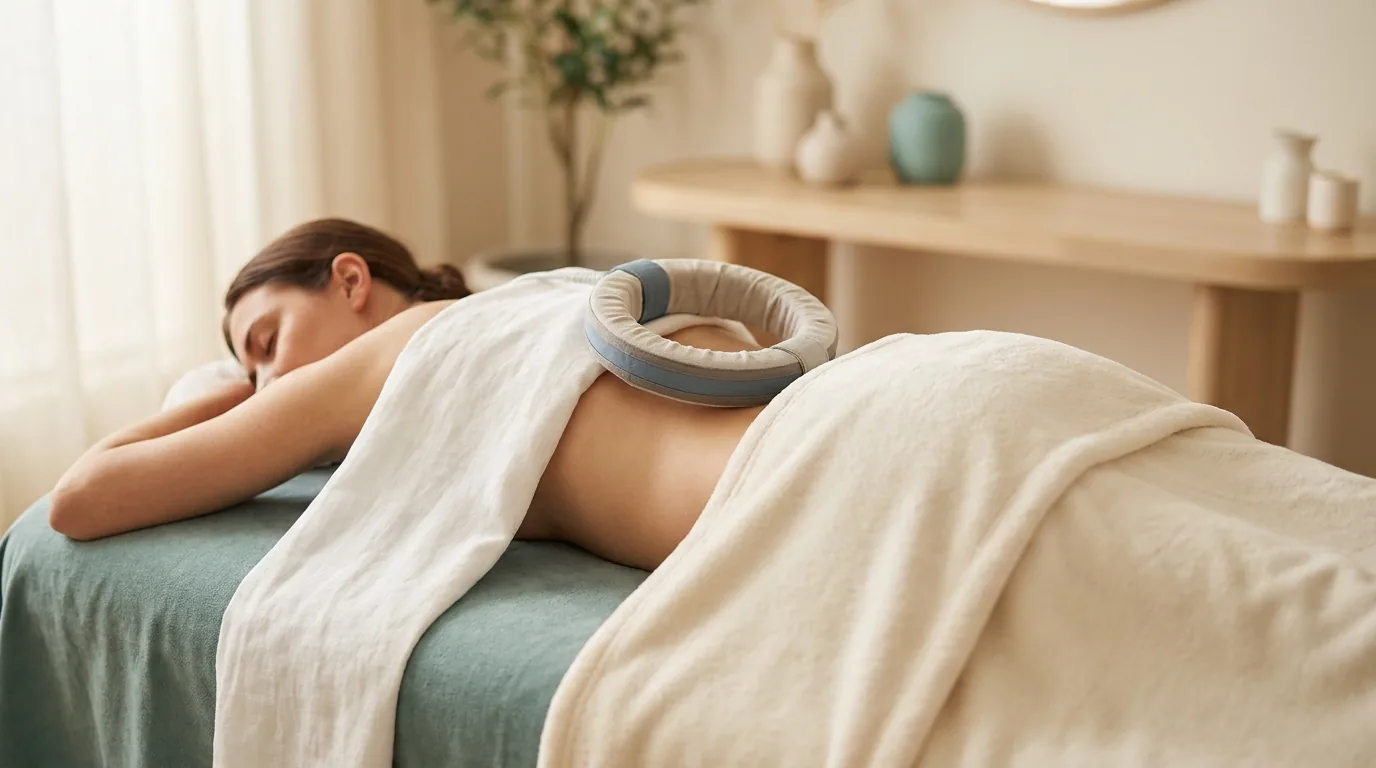
Pulsed electromagnetic field therapy delivers low-frequency magnetic pulses into tissue through a coil or mat placed over the area. You don't feel much — no heat, no shock, at most a faint sense of the coil resting there. It isn't new or fringe. Orthopedic medicine has used PEMF since the 1970s, first to help fractures that had failed to knit together, and later as an adjunct in osteoarthritis and post-surgical bone healing, where its safety profile is well established.
The proposed mechanism is cellular rather than mechanical. The pulses appear to influence how resident cells handle calcium signaling and energy production, nudging them toward repair activity and dampening some of the inflammatory chemistry that keeps pain switched on. That's the biology the lab studies describe. The honest caveat is that a plausible mechanism in a dish doesn't automatically translate to a person's lower back, which is why what the clinical trials show matters more than how good the theory sounds.
What the evidence says for back pain
Here's the careful version, because back pain is exactly the area where confident claims should make you suspicious. There is a body of randomized trial evidence suggesting PEMF can reduce pain and improve physical function in non-specific low back pain, at least in the short term. A 2023 systematic review of PEMF for non-specific low back pain concluded that it may improve pain and function, while flagging that the trials are limited in number and quality.1 A 2025 randomized controlled trial in mechanical low back pain likewise found electromagnetic field therapy improved outcomes compared with control.2
That's a real, if modest, signal. What it is not is a large, uniform, high-certainty evidence base of the kind that supports shockwave for plantar fasciitis. The studies are generally small, they use different devices and settings, and the better-designed ones tend to show more measured effects. The fair summary: PEMF probably helps some people with back pain somewhat, over the short term, and it does so safely. Anyone promising more than that is ahead of the data.
PEMF for back pain is supported by low-to-moderate-certainty evidence for short-term relief. It's a reasonable adjunct with a strong safety record — not a proven cure, and not a substitute for the movement and strengthening that actually resolve most back pain. We'd rather tell you that than sell you a package on a promise the research doesn't back.
What PEMF can't do
This is the part the marketing skips. Most ordinary back pain is mechanical: muscles that have deconditioned, a core that isn't sharing the load, joints and discs that have stiffened or changed with age and use. A magnetic field doesn't rebuild a weak muscle or retrain a movement pattern. What it can do is turn the pain down enough, and support the local tissue environment enough, that the things which do fix a back — graded movement, strengthening, better loading habits — become possible sooner and hurt less along the way.
That reframing matters because it changes what counts as success. If you expect PEMF to be the treatment, you'll judge it by whether the pain vanishes, and often be let down. If you understand it as the thing that makes the real work more tolerable, you'll use it the way it actually earns its keep.
How we use it — rarely on its own
In the clinic we almost never treat a back with PEMF alone, because on its own it's the least powerful lever in the room. Where it fits is as a layer. For the muscular and tendon component of back pain — the tight, guarded, chronically overworked tissue — we often pair it with radial shockwave, which does the more vigorous mechanical work, and let PEMF support the recovery in between. The combination is the same logic we use elsewhere in the body: shockwave provokes a response, PEMF supports what follows.
Above both sits the part that does the heavy lifting: a movement and loading program, whether that's guided physiotherapy or a structured home routine. We reassess at around the third session. If the back is responding, we consolidate and lean harder into the active rehab. If it isn't, we don't keep running the coil on faith — we step back and rethink the diagnosis, because a back that isn't improving may be telling us the problem is something the device was never going to touch.
When back pain needs a doctor, not a device
No article about back pain is complete without this, and PEMF's gentleness makes it easy to reach for when the real need is a proper medical assessment. Certain features mean the priority is evaluation, not therapy of any kind.
- The pain follows a significant fall or accident, or you have known or suspected osteoporosis.
- There's new weakness, numbness, or pins-and-needles in a leg, or any change in bladder or bowel control — the last of these is an emergency.
- The pain is worse at night, unrelieved by changing position, or comes with fever, chills, or unexplained weight loss.
- You have a history of cancer, a suppressed immune system, or ongoing steroid use.
And separately from the back pain itself, PEMF has its own list of people it's not for. It isn't used over a pacemaker, implanted defibrillator, or other active electronic implant, during pregnancy, or over an area with active infection or a known tumor. We screen for all of this before anything starts.
What to do next
If you've been eyeing a PEMF mat online or a clinic package for your back, the most useful first move is a proper assessment of what's actually causing the pain. For a lot of backs, PEMF has a modest, legitimate supporting role — most often alongside shockwave for the muscular part and a real strengthening plan for the rest. For some backs it's beside the point, and we'll tell you that. A good consultation sorts the difference, and it's the step that keeps you from paying for a device to solve a problem it was never built for. If you want the fuller picture of the combined pain protocol, our page on shockwave and PEMF for pain lays out how the two work together, and our write-up on stubborn shoulder pain shows the same approach applied to a different joint.