The patient who first prompted me to write this had been favoring his right shoulder for eleven months. He was a weekend tennis player, a desk worker the rest of the week, and the kind of man who waits until something stops him from sleeping before he books an appointment. By the time he sat down, he could no longer reach for a seatbelt without wincing. An MRI showed a calcific deposit in the supraspinatus tendon — the small ridge of tissue at the top of the rotator cuff — along with thickening of the subacromial bursa. He had already tried two corticosteroid injections, six weeks of physiotherapy, and a course of oral anti-inflammatories. He wanted to know if there was anything left short of surgery.
There usually is. The honest version of that answer involves two technologies that get talked about often and explained well almost never: radial shockwave therapy, and pulsed electromagnetic field therapy, or PEMF. Used together, with the right diagnosis and a realistic schedule, they resolve a large fraction of chronic shoulder pain that has refused to behave.
Why a shoulder gets stuck in pain
The shoulder is a strange joint. It trades stability for range of motion — almost any direction is possible — and the price is a complicated stack of tendons, bursae, and a capsule that all have to glide cleanly against bone. Most chronic shoulder pain falls into one of three patterns. Calcific tendinopathy is the slow accumulation of calcium hydroxyapatite crystals inside a rotator cuff tendon, usually the supraspinatus. Subacromial impingement happens when the space between the tendon and the bone above it narrows, often from posture, repetitive overhead loading, or simple age. Adhesive capsulitis — frozen shoulder — is a thickening and tightening of the joint capsule itself, often appearing in middle-aged adults and disproportionately in people with diabetes.
What all three share is a self-feeding loop. Tissue gets irritated, the body sends inflammatory cells, the inflammation lingers past its useful window, scar tissue forms, the area moves less, and the moving-less makes the area more irritable. Once a shoulder is in that loop, time alone often doesn't break it. The patient described above had been doing what most people do — protecting the joint, hoping it would settle, slowly losing range — and the inflammation had simply outlasted his patience.
How radial shockwave actually works
Shockwave therapy is the cousin of the lithotripsy technology that has been used to break kidney stones for decades. In the orthopedic version, acoustic pressure waves are delivered through the skin into deeper tissue, where they create mechanical and biological effects. There are two main types, and they are not interchangeable.
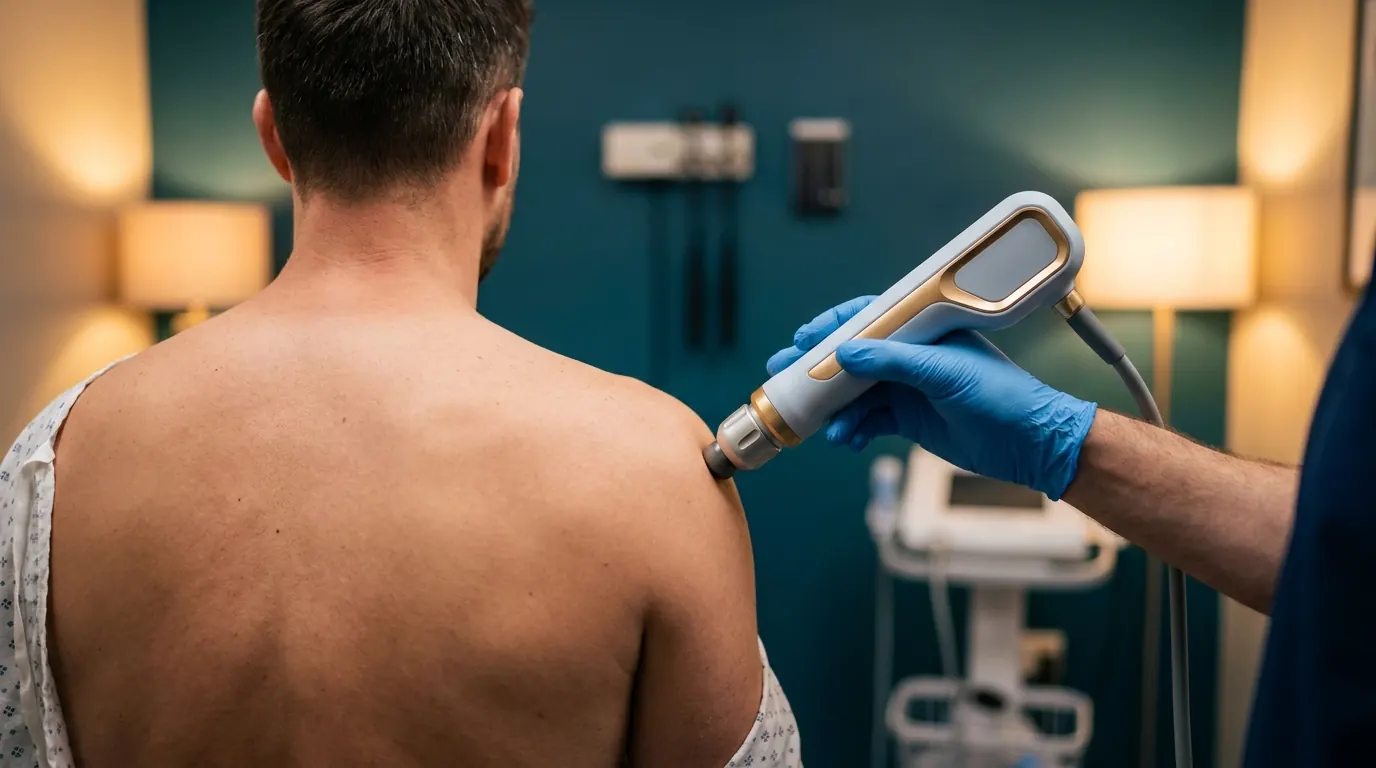
Radial shockwaves are generated by accelerating a small projectile inside a handpiece using compressed air; the projectile strikes an applicator pressed against the skin, and a pressure wave radiates outward from that point. Energy is broader and shallower — most of it concentrated in the first three to four centimeters of tissue.1 Focused shockwaves are generated electromagnetically, electrohydraulically, or piezoelectrically inside the device and converge to a precise focal point ten to twelve centimeters below the skin.1 For most shoulder applications — where the relevant tendon sits just under a layer of deltoid muscle — radial waves cover the working depth well, with the added advantage of a wider treatment field. For deep calcific deposits, some practitioners prefer focused energy.
What the waves do once they arrive is part mechanical, part biochemical. They appear to disrupt calcium deposits, stimulate local microcirculation, and trigger a fresh inflammatory response in tissue that had become chemically "quiet" — releasing growth factors, recruiting healing cells, and giving a chronic problem a brief, controlled reset.2
The most recent meta-analyses (2024) of extracorporeal shockwave therapy for rotator cuff tendinopathy show clinically meaningful improvements in pain and function compared to sham treatment, sustained out to six months — strongest for calcific tendinopathy, with radial shockwaves especially effective at the three- and six-month mark.2,3 The evidence base isn't perfect, and the authors note none of the included trials was rated low risk of bias. But the signal is consistent.
What PEMF adds to the picture
If shockwave is the loud, mechanical part of the conversation, PEMF is the quiet one. Pulsed electromagnetic field therapy delivers low-intensity electromagnetic pulses through tissue. Patients feel almost nothing during it. The technology has been used in orthopedics since the 1970s, originally for non-healing bone fractures, and has expanded into soft-tissue work as the cellular research has caught up.
What PEMF appears to do is influence the cellular machinery of repair. Studies on tendon cells show that pulsed fields affect proliferation, gene expression, and the release of cytokines involved in tissue healing.4 A 2024 randomized trial in shoulder impingement syndrome found PEMF significantly improved short-term pain scores and short- and long-term functional capacity compared to controls.5 Animal models of rotator cuff repair show enhanced tendon-to-bone healing with PEMF at multiple frequencies.6
The reason we combine the two is that they act on different parts of the same problem. Shockwave provokes a vigorous, focal response — useful for breaking the stalemate. PEMF provides a gentler, ongoing biological nudge in the days between sessions, supporting the healing that the shockwave just initiated. Neither is a magic technology in isolation; together they tend to do better than either alone.
A typical session sequence
Most patients we see for chronic shoulder pain follow a similar arc. Before starting, we want recent imaging — usually an ultrasound, sometimes an MRI — to confirm what we are actually treating. Shockwave protocols differ for calcific versus non-calcific tendinopathy, and there are conditions where it should not be used at all.
| Session | What happens | What you notice |
|---|---|---|
| Session 1 | Diagnostic review, ultrasound mapping of the painful zone, first round of radial shockwave (typically 2,000 pulses at moderate energy), followed by 10–15 min of PEMF over the shoulder. | A deep, tolerable ache during shockwave. Sometimes 24–48 hours of soreness after — like a heavy workout. |
| Session 2 | One week later. Reassessment of pain and range of motion. Same shockwave protocol if tolerance was good; energy adjusted up if needed. PEMF after. | Many patients report the "easy" positions (reaching forward) start to feel slightly looser. |
| Session 3 | One week later. By this session most patients have a clear sense of whether they are responding. Range of motion is measured again. | Sleeping on the affected side is often the first thing that improves. |
| Sessions 4–6 | Weekly, as needed. Patients with calcific deposits often need the full course; mild impingement may resolve in three. | Functional gains — reaching overhead, behind the back — usually trail pain improvements by a few weeks. |
Three sessions one week apart is the most evidence-supported starting point, with the option to extend to six depending on response.7 Each shockwave session takes about ten to fifteen minutes for the device work; the full visit including PEMF and assessment runs forty-five minutes to an hour. We schedule weekly because the tissue needs time to respond between treatments — closer than that wastes pulses, further apart loses momentum.
Who isn't a good candidate
Honest answers about what doesn't work matter as much as the ones about what does. Shockwave is not appropriate in several specific situations, and PEMF has its own list.
- You are on therapeutic anticoagulation or have a clotting disorder — shockwave can cause hematoma in the treatment field.
- You have a pacemaker or implanted defibrillator. PEMF is contraindicated, and shockwave near the device is avoided.
- There is active infection, open wound, or known malignancy at or near the treatment site.
- You are pregnant (we don't treat near the abdomen, but the safety data more broadly is limited).
- You have a full-thickness rotator cuff tear on imaging — this is usually a surgical conversation, not a shockwave one.
- The pain is acute (less than six weeks) and we haven't given conservative care a fair trial yet.
The bigger group worth flagging is patients whose pain is actually coming from somewhere else. Cervical spine referred pain, thoracic outlet syndrome, even cardiac pain in the left shoulder can mimic rotator cuff disease. A careful exam and good imaging rule these out before we touch the device.
When physiotherapy belongs in the picture
The clinic almost never treats a chronic shoulder with shockwave alone. The technology gives the tissue a chance to heal; physiotherapy teaches the joint how to use that chance. Without targeted strengthening and mobility work, the same patterns that caused the problem will reproduce it.
For most patients we recommend physiotherapy beginning around the second or third shockwave session, once acute pain has stepped down enough for active work. Sooner than that, the patient is too sore to engage well; later than that, the muscle disuse compounds. Evidence supports the combination: studies of ESWT paired with structured physiotherapy for rotator cuff tendinopathy and adhesive capsulitis show better functional outcomes than either intervention in isolation.8,9
This is the part that takes patience. Most patients want the device to fix it. The device, used correctly, opens a window. What you do during that window — the scapular strengthening, the posterior capsule stretches, the rotator cuff retraining — decides whether the gains hold at six months or whether the shoulder slowly slides back to where it was.
What to do next
If you have had shoulder pain for more than three months, have already tried rest and basic anti-inflammatories, and are looking for something between "keep waiting" and "consider surgery," this combination is worth a conversation. Bring any imaging you've had — ultrasound, MRI, X-ray. A good first consultation is mostly diagnosis: figuring out exactly what is hurting, why it is hurting, and whether shockwave and PEMF are the right tools for your particular pattern. They are not the answer for everything. For the right shoulders, in the right hands, with the right physio support, they are quietly one of the most useful answers we have.