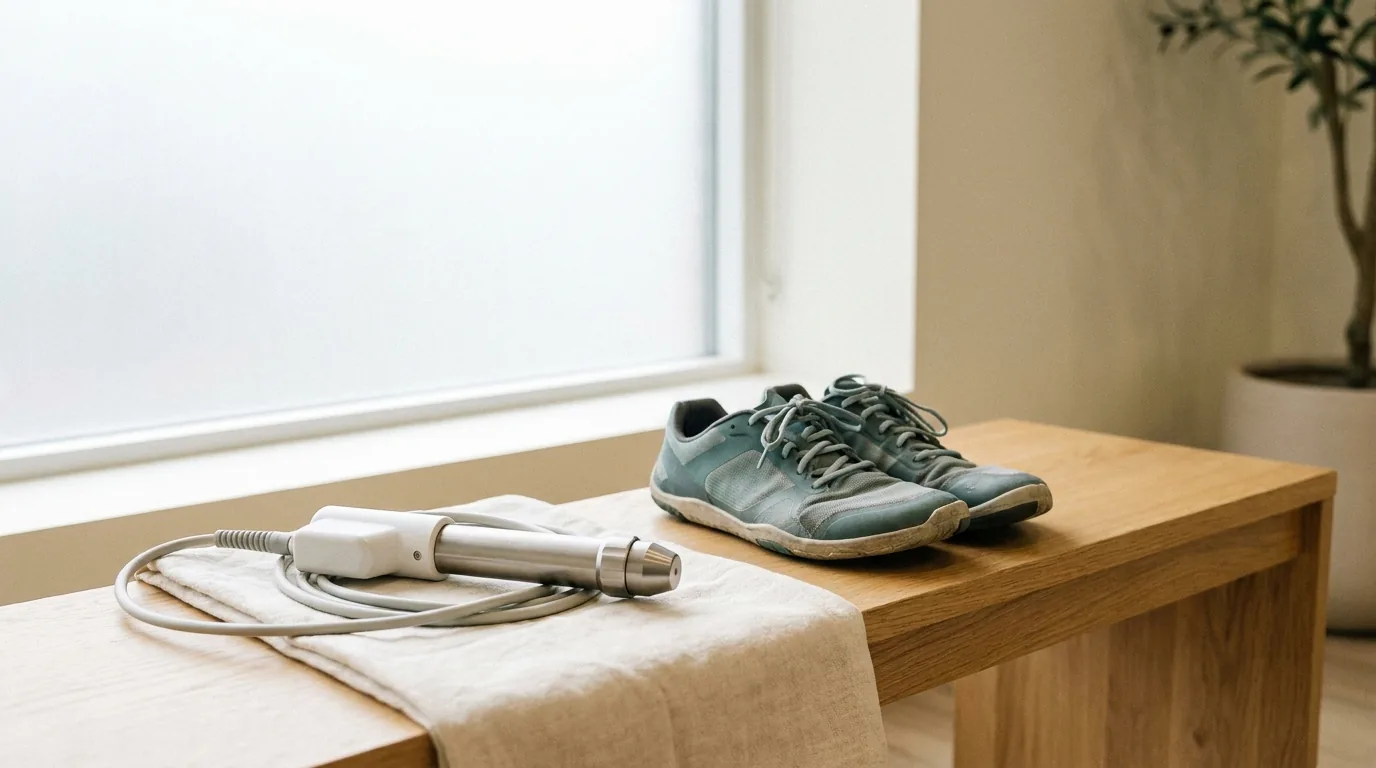
Most sports injuries that drag on for months aren't the ones that make you fall to the ground. They're the slow-burn tendon problems: the Achilles that's tight and sore for the first kilometer, the knee that aches after every jump session, the elbow that flares with each backhand or heavy pull. These are tendinopathies — overuse injuries where a tendon has been loaded past its capacity often enough that it stops repairing properly. They're the bread and butter of sports medicine, and they're exactly what shockwave was made for.
Why tendons get stuck
A healthy tendon adapts to load. Train, recover, and it gets stronger. Push too hard too often, or ramp up too fast, and the balance tips: micro-damage outpaces repair, the tendon's structure gets disorganized, and it settles into a low-grade, chronic state that pain and rest alone don't fix. Rest takes the pain away for a while, but the moment you load it again it returns, because rest never rebuilt anything. That's the trap active people fall into — a cycle of flare, back off, return, flare — and it's the loop shockwave is designed to break.
What shockwave does for a sports tendon
Radial shockwave delivers acoustic pressure waves into the sore tendon, and they do two useful things: disrupt the disorganized, degenerated tissue, and trigger a fresh healing response in a tendon that had gone quiet — new blood flow, growth factors, repair cells called back to a job they'd abandoned.1 In effect it converts a stalled chronic problem into an active one your body will work on again. That's why it suits tendinopathy so well, and why it does nothing for a fresh muscle tear, which is already in an active healing phase and needs protecting, not provoking.
The sports injuries it treats well
| Injury | Common in | Notes |
|---|---|---|
| Achilles tendinopathy | Runners, court sports | Both mid-portion and insertional; among the best-studied uses. |
| Patellar tendinopathy (jumper's knee) | Basketball, volleyball, jumping sports | Chronic tendon pain below the kneecap in active people. |
| Lateral / medial epicondylitis | Tennis, golf, climbing, lifting | Tennis elbow has the stronger evidence of the two. |
| Proximal hamstring tendinopathy | Runners, sprinters | Deep sit-bone pain that worsens with speed work and sitting. |
| Greater trochanteric / gluteal tendinopathy | Runners, hikers | Outer-hip pain often mislabeled as "bursitis." |
| Plantar fasciitis | Runners, jumpers | Heel pain; see our full plantar fasciitis guide. |
Across these tendon conditions, pooled trial data land in a similar place — meaningful improvement in pain and function for a large share of patients, best where the problem is genuinely chronic.1,2 For a fuller map of what shockwave does and doesn't treat, see our guide to radial shockwave for chronic pain.
What the evidence says for athletes
This is a use with real backing. A 2024 international expert consensus in sports medicine supports extracorporeal shockwave therapy for athletes with tendinopathy and lays out how to use it sensibly, including during a competitive season.2 The in-season point matters: because shockwave needs no downtime and no anesthetic, it can be scheduled around training and games in a way that surgery, injections, and long immobilization can't.3 The consensus is equally clear that it isn't a magic bullet — it belongs inside a loading and rehabilitation program, not instead of one.
For chronic sports tendinopathy that has failed rest and basic rehab, shockwave combined with progressive loading is one of the better-supported non-surgical options in sports medicine. It's most useful precisely when an athlete is stuck — training limited, months in, nothing else working.
The honest timeline back to sport
Here's where expectations most often go wrong. The shockwave session itself has no downtime — you can usually train the same day at reduced intensity. But the benefit isn't immediate, because it's driven by tendon remodeling, which takes weeks. Most athletes notice real change between the third session and around the three-month mark, and it continues improving after the last session as the tendon rebuilds. If you're chasing a hard deadline — a race, a tournament — the honest advice is to start early and pair it with loading, not to expect a quick fix the week before.
Why loading is non-negotiable
Shockwave opens a biological window; what you do in that window decides whether the tendon actually gets stronger. Progressive loading — the specific, graded strengthening a physiotherapist or sports clinician prescribes for your tendon — is the part that builds capacity so the injury doesn't simply return when you ramp training back up. We treat shockwave and loading as a package. Skipping the loading is the single most common reason a treated tendon relapses.
When it's the wrong tool
- The injury is acute — a fresh muscle tear, ligament sprain, or anything in the first few weeks needs protection and diagnosis first, not shockwave.
- A fracture or a full tendon or muscle rupture is suspected — these need imaging and often a surgical or specialist opinion.
- The problem hasn't been diagnosed. "Knee pain" or "shoulder pain" isn't a diagnosis, and treating the wrong thing wastes time and money.
- There's active infection or a tumor at the site, you're pregnant, or you're on strong blood thinners.
What to do next
If a tendon has been limiting your training for months and rest hasn't fixed it, shockwave plus a loading plan is worth a proper conversation. Bring your history — what aggravates it, what you've tried, any imaging — and expect the first visit to be mostly diagnosis: pinning down exactly which tendon and how to load it, then deciding whether a short course of shockwave is a smart bet for getting you back to sport. For the right stubborn tendon, it's one of the most useful tools we have.