Ride a big bike? The same radial shockwave and PEMF work is offered as a rider recovery and health check — wrists, shoulders, lower back and knees, the four places long rides show up first.
Almost everyone who books an appointment for heel pain describes the same morning. You swing your legs out of bed, put weight on the foot, and the underside of the heel lights up as if you'd stepped on a marble. A few limping steps later it eases off. By mid-afternoon you've half-forgotten it — until you stand up after lunch and it's back. That first-step pain, worst in the morning and after rest, is the signature of plantar fasciitis, and it's one of the most common reasons a physically active adult ends up favoring one foot for months.
The plantar fascia is a thick band of connective tissue that runs along the sole from the heel bone to the base of the toes, holding up the arch like a bowstring. When it's repeatedly overloaded — long hours standing, a jump in running distance, flat unsupportive shoes, tight calves, extra body weight — the tissue where it anchors to the heel becomes irritated and, over time, degenerative. The name is a little misleading. In chronic cases it's less an active inflammation and more a stalled, failed healing process. That distinction matters, because it's exactly the kind of stuck tissue that shockwave is designed to restart.
So does it actually work?
Short answer: for chronic plantar fasciitis, yes, and the evidence is reasonably good. Extracorporeal shockwave therapy has been studied for this condition more than for almost any other tendon or fascia problem, and it's one of the few non-surgical options the podiatric and orthopedic literature genuinely backs.
A 2024 systematic review and meta-analysis pooling the trial data found that both radial and focused shockwave produced significant reductions in heel pain — on the order of a three-point drop on a standard ten-point visual scale, which is the difference between limping and getting through your day.1 Other reviews put shockwave ahead of ultrasound therapy, and found it matches corticosteroid injection for pain relief while lasting longer and avoiding the thinning of the fascia and fat pad that repeat steroid shots can cause.2,3 The US FDA cleared shockwave for chronic plantar fasciitis years ago, specifically for pain that has persisted past six months and resisted conservative care.
The honest boundary of the evidence: shockwave helps most when the pain is chronic and recalcitrant, meaning it's been there a while and simpler measures have failed. The reviews are clear that it beats placebo, but they also note the trials vary in quality and in the exact settings used. It is a good tool for the right foot, not a guarantee for every foot.
Why it works — the mechanism in plain terms
Shockwave delivers acoustic pressure waves through the skin into the sore tissue. In the radial version we use for the heel, compressed air drives a small projectile inside a handpiece against an applicator pressed on the foot, and the energy spreads out from that point into the first few centimeters of tissue — which is right where the fascia anchors to the heel bone.4
Once the waves arrive, two useful things happen. Mechanically, they seem to break up the disorganized, degenerated tissue and any small calcium deposits that have formed. Biologically, they provoke a fresh, controlled healing response in tissue that had gone chemically quiet — drawing in blood flow, releasing growth factors, and nudging the body to finish a repair it had abandoned. In effect, shockwave turns a chronic, stalled problem back into an acute one that the body will actually work on.
How many sessions, and how long until it helps
This is the part people most want a straight answer on, so here it is. Across the trials, the most common protocol is three radial sessions spaced one week apart, each delivering a couple of thousand pulses over the sore area.1 Some longer-standing cases need a fourth or fifth session. That's the honest range — not one miracle visit, and not an open-ended commitment.
Timing of relief is where expectations most often go wrong. Because shockwave works by starting a healing process rather than blocking pain, you don't walk out cured. Most people notice the first real change somewhere between the third session and about six weeks in, and pain and function keep improving for roughly two to three months after the final session as the tissue remodels.1 If you're picturing a painkiller, you'll be disappointed at week one. If you understand it as a repair signal, the timeline makes sense.
| Stage | What happens | What you notice |
|---|---|---|
| Session 1 | Exam and diagnosis first, then the sore band of fascia is mapped and treated with radial shockwave. Intensity is set to what you can tolerate. | Deep tapping pressure during treatment. Sometimes a day or two of mild soreness afterward. |
| Session 2 | One week later. We check how the heel responded and adjust the energy if you tolerated the first round well. | Often no dramatic change yet — this is normal and not a sign it's failing. |
| Session 3 | One week later. By now most people have a sense of the direction of travel. We reassess and decide whether a fourth session is worth it. | The morning first-step pain is usually the first thing to ease. |
| Weeks 4–12 | No more device work for most patients. The tissue continues remodeling. We add calf stretching and load management. | Steady improvement in walking distance and standing tolerance. |
What a session actually feels like
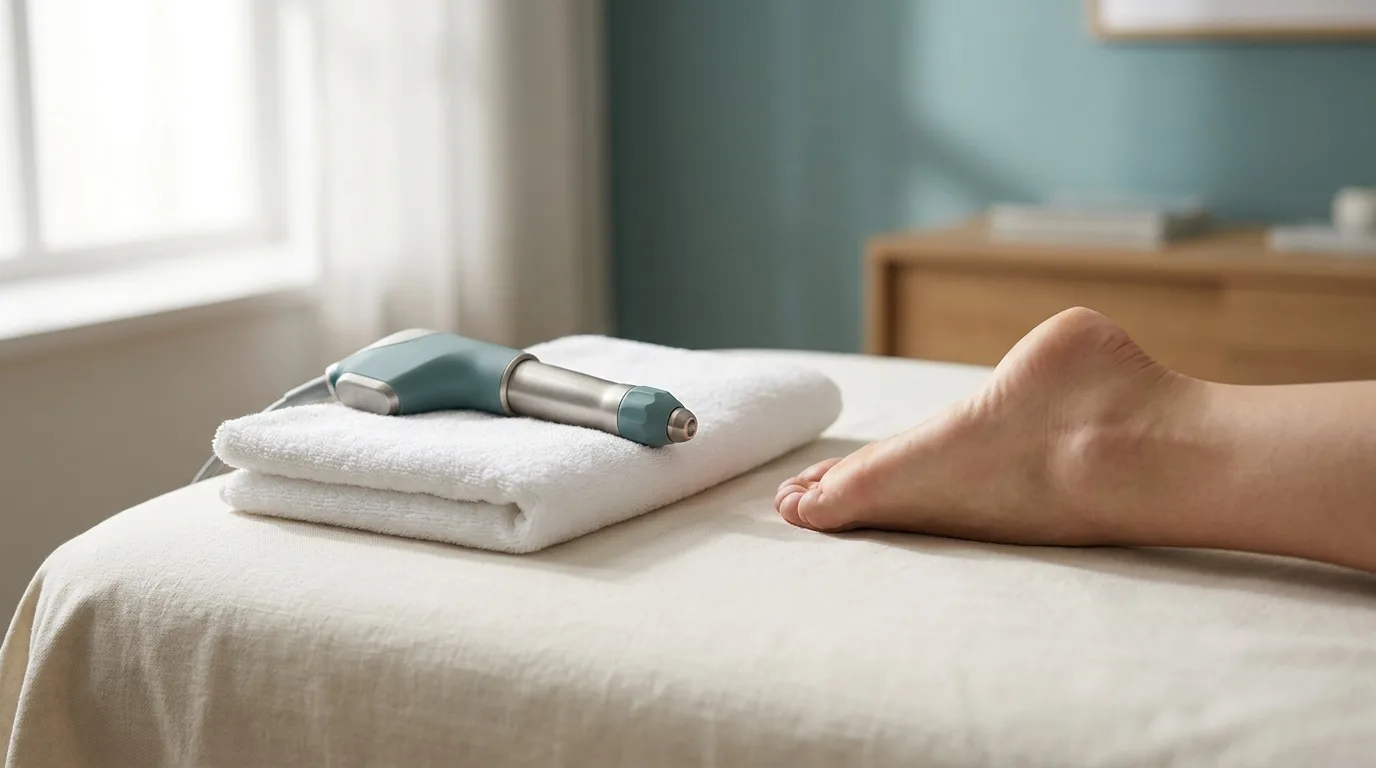
The heel is a sensitive spot, and there's no point pretending shockwave there is relaxing. During treatment you feel a firm, percussive tapping concentrated over the tender area. It can be briefly uncomfortable at higher energies, which is exactly why the intensity is adjustable and we titrate it to you rather than to a fixed number. Each area takes only a few minutes of device time. You stay clothed apart from the foot, no anesthesia is involved, and you can drive yourself home and walk normally the same day. The most common after-effect in the trials was temporary redness over the treated skin, which settles quickly.1
When shockwave is the wrong answer
The most useful thing a clinic can tell you about heel pain is when not to reach for the device. Plantar fasciitis is common, but it isn't the only cause of pain under the heel, and the imitators don't respond to shockwave.
- The pain is a calcaneal stress fracture, nerve entrapment (such as Baxter's nerve), or a thinned heel fat pad — these feel similar but need different treatment, so imaging or a careful exam has to come first.
- You take any anticoagulant — warfarin, rivaroxaban, apixaban, dabigatran, edoxaban — or have a bleeding disorder — shockwave can cause bruising in the treated area.
- There's active infection, an open wound, or a known tumor at or near the heel.
- You're pregnant — the broader safety data is limited, so we hold off.
- The pain only started a few weeks ago and hasn't been given a fair trial of stretching, supportive footwear, and load reduction. Many acute cases resolve without any procedure.
There's also a group of patients for whom shockwave is worth doing but won't be enough on its own. If tight calves, poor footwear, or a sudden training spike caused the problem, treating the heel without fixing the load simply invites it back. That's why we pair the device work with calf and plantar stretching, footwear advice, and a gradual return to activity. The shockwave opens a window; what you do in that window decides whether the relief holds.
How it fits with everything else you've tried
Most people arrive having already done the sensible first things: rest, ice, over-the-counter anti-inflammatories, a pair of arch supports, maybe a course of stretching from a physiotherapist. For a lot of heels, that's enough. Shockwave enters the picture when three to six months of that hasn't settled it and the choice starts to feel like a jump from "keep waiting" to a corticosteroid injection or, rarely, surgery. It sits neatly in that gap: more active than waiting, less invasive than an injection into the fascia, and without the tissue-weakening risk that repeated steroid shots carry.3
If your heel pain has a shoulder or elbow cousin, the same combined approach we use for those applies here, and we've written separately about how radial shockwave and PEMF work together for stubborn tendon pain. For the difference between the two kinds of shockwave devices, our focused versus radial explainer covers which is used where and why.
What to do next
If you've had heel pain for more than three months, it's worst on your first steps in the morning, and the basic measures haven't moved it, shockwave is worth a proper conversation. Bring any imaging you've had — an X-ray or ultrasound helps — but the most valuable part of a first visit is simply the exam: confirming this is plantar fasciitis and not one of its lookalikes, and being honest with you about whether three or four sessions are a realistic bet for your particular foot. For the right heel, it's one of the quietly useful tools we have.